In a world where the line between liberation and servitude blurs like a half-remembered dream, Acurast-a name that drips with the faux-sincerity of modern technocratic utopias-has “activated” a 225,000-node smartphone “compute network” on Base. One might call it a triumph of Web3’s grand delusion: to turn the humble, privacy-starved masses into unwitting laborers for an AI overlord. After all, who needs data centers when you’ve got 225,000 unwitting accomplices with fingerprint sensors?
Base, that noble Ethereum Layer-2 chain, now hosts this marvel, promising developers the ability to run “confidential AI workloads” onchain. A charming oxymoron, if ever there was one. Why rely on centralized infrastructure when you can trust the collective wisdom of smartphones, each a tiny, glowing vault of your deepest secrets? Acurast’s solution? Let’s not call it a privacy safeguard-let’s call it a bureaucratic sleight of hand, where Trusted Execution Environments (TEEs) become the latest buzzword for “we hope nothing goes wrong.”
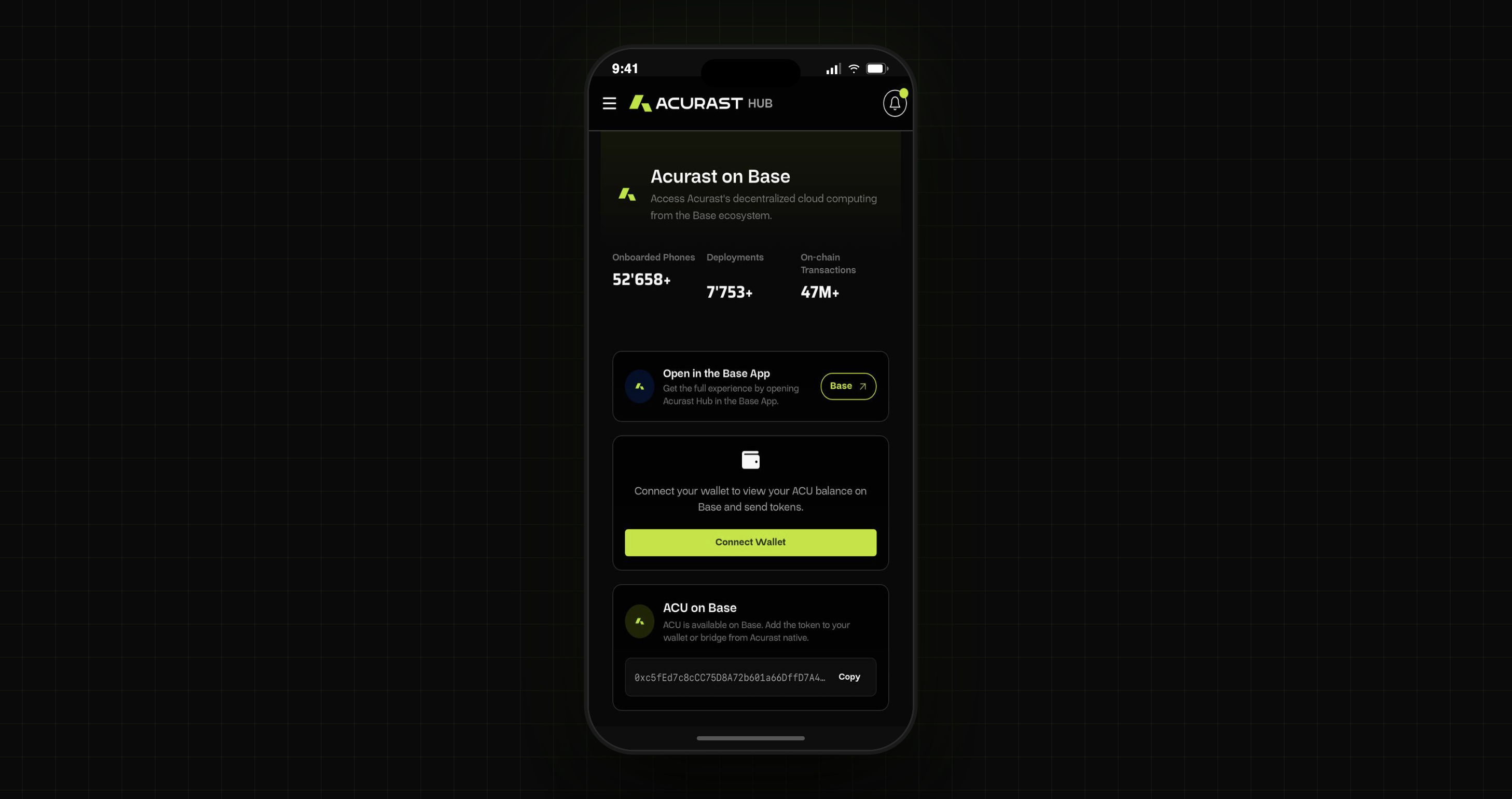
Smartphones are the new cloud
Acurast’s vision? To harness the billions of smartphones already scattered like digital landmines across the globe, stitching them into a “decentralized compute layer.” A poetic metaphor, really: instead of centralized servers, we now have centralized chaos. The risk of censorship? Gone, replaced by the subtler tyranny of device fragmentation and carrier contracts. And let’s not forget the 140 countries where these tasks will “run securely”-a term as vague as a politician’s promise.
Jesse Pollak, Base’s creator, waxed lyrical: “Base is about giving builders the best place to bring new ideas on-chain.” Ah, yes, because nothing says “freedom” like building on a platform that requires you to dance to its tokenomics tune. Acurast, he claims, expands the “surface area” of Web3. One wonders if he’s referring to the expanding cracks in the edifice of trust we’re all being asked to ignore.
The network, now live on Base’s mainnet, “handles production workloads securely.” A phrase so delightfully ambiguous it could mean anything from “we’ve encrypted the data” to “we’re still figuring out how to handle errors.”
Alessandro De Carli, Acurast’s founder, declared: “AI agents cannot rely solely on centralized servers if they are tasked with managing real assets onchain.” A profound insight, delivered with the gravitas of a man who’s never seen a centralized server fail spectacularly. By leveraging smartphones, we’re supposedly enabling “confidential AI that is verifiable, decentralized, and owned by the users who power it.” A sly twist of language, as if ownership isn’t just another word for “you signed up for this.”
Confidential AI, native payments
Acurast’s payment system now supports USDC on Base, bypassing “bridging or offchain settlement layers.” A bold move, akin to claiming you’ve eliminated bureaucracy by replacing one form of paperwork with another. The x402 standard, they say, allows AI agents to pay for compute resources “in real time.” A phrase that sounds urgent until you realize the “real time” is measured in milliseconds of your device’s battery life.
This “pay-per-request model” for decentralized services is heralded as a revolution. Yet one can’t help but wonder: when AI agents autonomously settle fees in USDC, what exactly are they buying? The illusion of autonomy, perhaps. After all, the only thing more autonomous than an AI agent is a man in a lab coat pretending he doesn’t work for the state.
A new layer for onchain AI workloads
Developers can now manage infrastructure via the Acurast Hub, a portal that promises “secure, autonomous AI agents.” These bots, they claim, will execute trades, manage assets, and perform on-chain reconciliations-all while keeping inputs and outputs “encrypted and unseen.” A comforting thought, if you’re the one doing the encrypting. The TEEs, they remind us, ensure that neither device owners nor external observers can access data during processing. A noble goal, undermined by the simple fact that most device owners don’t even know their phones are working overtime as digital serfs.
Beyond data centers
This expansion, Acurast boasts, follows “strong growth” in 2025, moving from “tens of thousands to hundreds of thousands of phones.” A growth spurt that feels less like a revolution and more like a viral marketing campaign. With its token now trading on exchanges, Acurast aims to build “a new class of onchain applications.” Decentralized, verifiable, confidential, and autonomous-by design, or by delusion?
In the end, Acurast’s grand experiment is a mirror held up to our times: a world where the line between innovation and exploitation is drawn in the same ink as the terms of service we never read. Whether this is the future or a cautionary tale remains to be seen-but one thing is certain: the phones are listening. And they’re working overtime.
Read More
- Gold Rate Forecast
- USD CNY PREDICTION
- Silver Rate Forecast
- USD THB PREDICTION
- Brent Oil Forecast
- DeFi Meltdown: Yearn Finance’s yETH Pool Drained by a Rogue Algorithm 🤖💸
- AI and Copyright: Mark Twain’s Take on the Modern Patent Circus
- Will Bitcoin and Ethereum Survive the $2B Options Expiry Drama?
- Gold Tokens: The New Gold Rush or Just Fool’s Gold? 🤔💰
- Bitcoin Plummets Below $98K: Fear Grips Market Like a Bad Soap Opera 🎭
2026-02-24 15:43