As an analyst, I’m seeing a significant shift in the crypto space: AI agents are rapidly becoming active traders, researchers, and operational forces. It’s a fast-moving trend, and many exchanges, data providers, and infrastructure companies are scrambling to equip these AI systems with everything they need to function effectively.
Crypto Industry Races to Equip AI Agents With Trading and Wallet Tools
The rapid rise of autonomous AI agents has fueled a sprawling ecosystem of integrations tied to Openclaw, an open-source framework for autonomous agents previously known as Clawdbot and Moltbot. Since late 2025, Openclaw has accumulated more than 250,000 Github stars and sparked a wave of tools designed to let AI agents trade assets, access blockchain data, manage wallets, and even launch tokens on their own.
At the heart of this shift is the idea that AI agents can operate as independent economic actors—executing trades, sending digital assets, analyzing markets, and interacting with blockchains without constant human supervision. Developers are building these systems using modular capability packages (MCPs), standardized payment protocols like x402, and onchain identity systems such as 8004, forming the technical backbone of what many developers are calling the emerging “agent economy.”
Exchanges and Trading Platforms on the Move
Exchanges have been among the fastest to embrace the trend, eager to ensure that if autonomous agents are going to trade crypto, they will likely do it on their platforms.
Binance, the world’s largest crypto exchange by volume, released seven AI agent skills, including Binance Spot Skill, Query Address Info, Query Token Info, Crypto Market Rank, Meme Rush, Trading Signal, and Query Token Audit. These tools allow AI systems to query blockchain data, assess token security, track market rankings, and execute trades through standardized interfaces compatible with Openclaw agents.

Other trading platforms quickly followed. OKX introduced Openclaw-compatible tools through its OnchainOS framework, enabling AI agents to manage wallets, initiate payments, read market data, and execute trades with permission-based controls designed to prevent runaway automation.
Crypto.com rolled out its “Agent Key” feature, a secure API access system that allows AI agents to trade with built-in safeguards such as weekly spending caps and scoped permissions. The company says the system enables both retail and institutional users to deploy trading agents without granting full access to accounts.
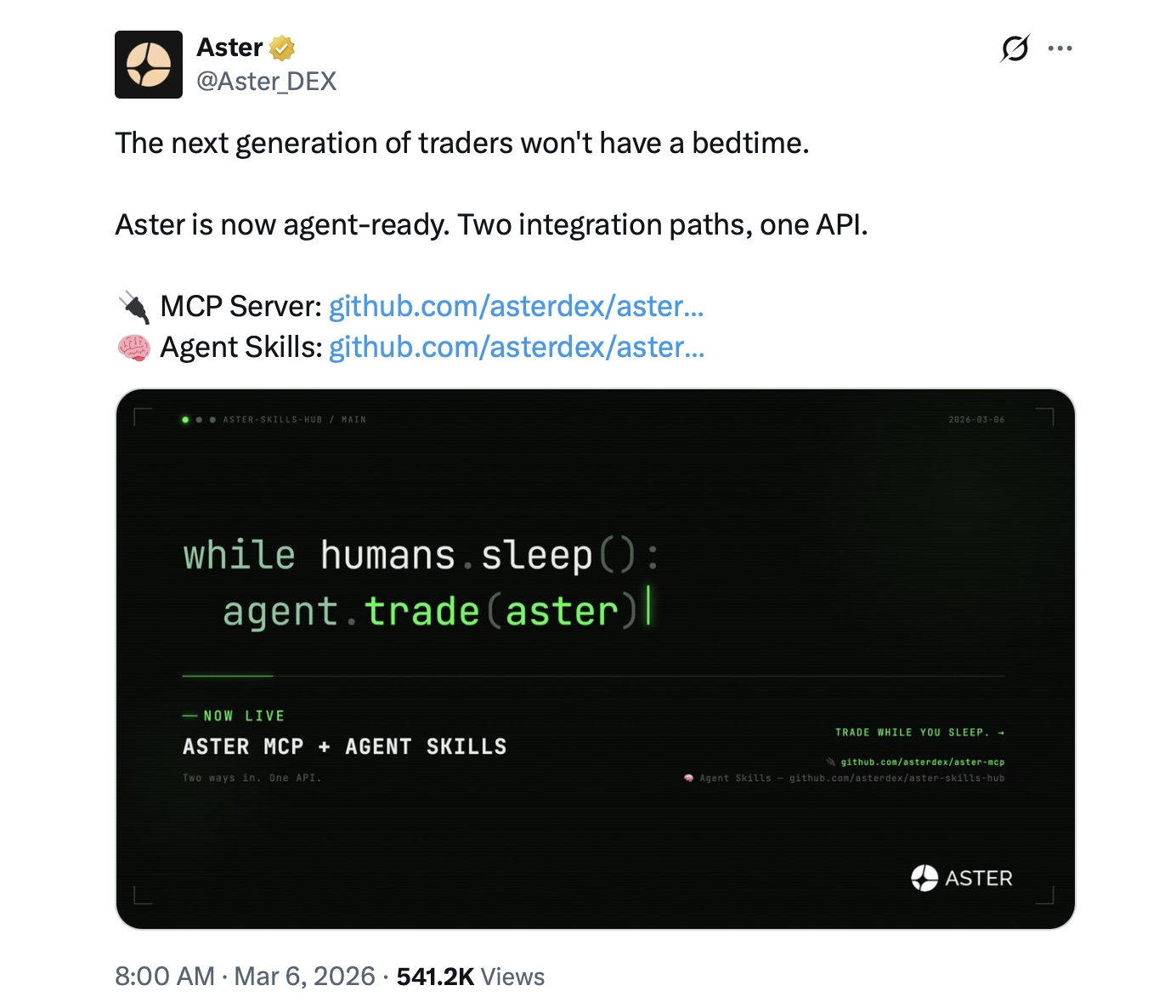
Decentralized exchange ( DEX) platforms are also getting in on the action. Pancakeswap launched “PancakeSwap AI,” giving agents the ability to swap tokens, manage liquidity positions, and run yield farming strategies automatically onchain. The largest DEX by trading volume, Uniswap, has also released agentic skill sets.
“Agents execute on Uniswap,” the DEX wrote earlier this week. “We’ve released seven new Skills giving structured access to core Uniswap protocol actions. Your starting point for agentic workflows onchain.”
This week, Mastercard disclosed a partnership with Google to develop “Verifiable Intent,” an initiative designed to advance agentic commerce, including applications involving x402. “When AI agents act with real money, consumers aren’t just looking for speed or convenience,” Mastercard wrote.
The payments giant added:
People need to know exactly what was approved, be sure instructions were carried out correctly, and feel safe if issues arise. As systems become more independent, trust isn’t automatic—it has to be earned.
Another crypto infrastructure firm expanding into AI-driven markets is Bitget Wallet, which released an Openclaw-compatible skill that allows agents to monitor whales, analyze K-line data, check token contract security, and identify arbitrage opportunities across multiple blockchains.
Data and Analytics Firms Feed the Machines
For AI to trade in financial markets on its own, it requires a consistent and trustworthy source of information. Data analytics companies are now providing this essential service.
Coinmarketcap (CMC), for instance, launched a modular capability package that provides real-time cryptocurrency market data to AI agents. The company also integrated x402 payment support for API usage and released specialized skills designed for Openclaw agents and Claude Code integrations.
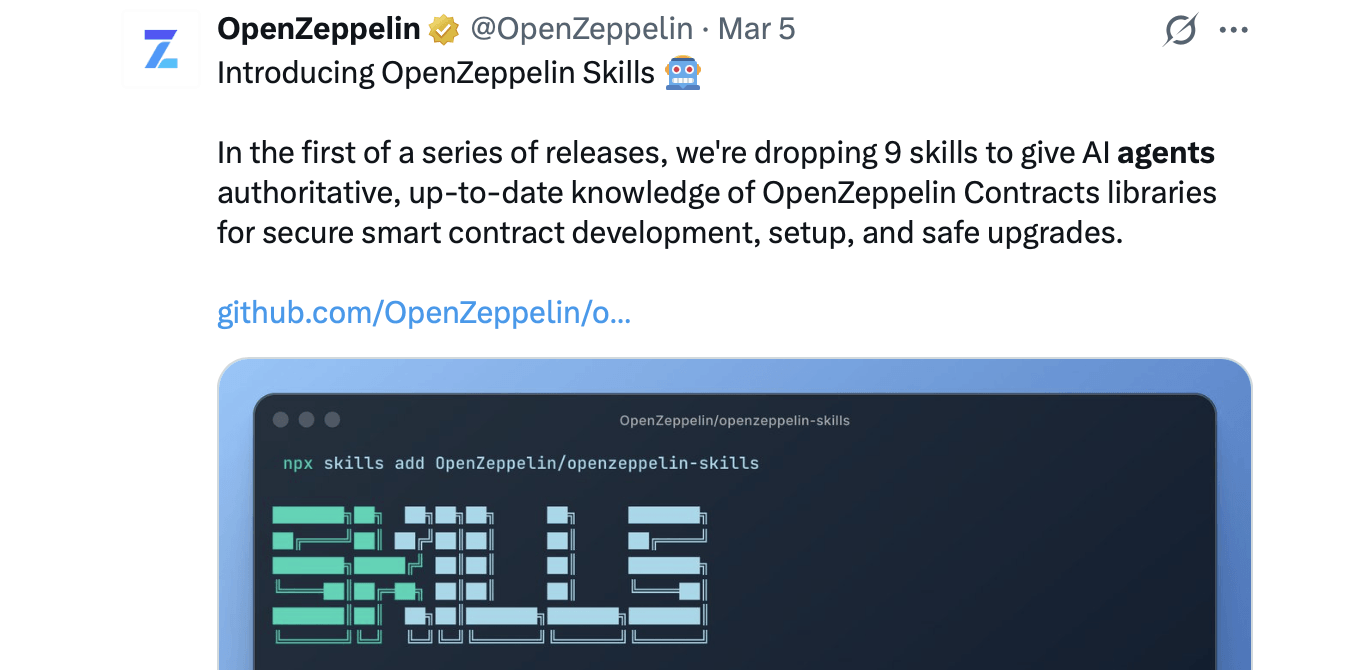
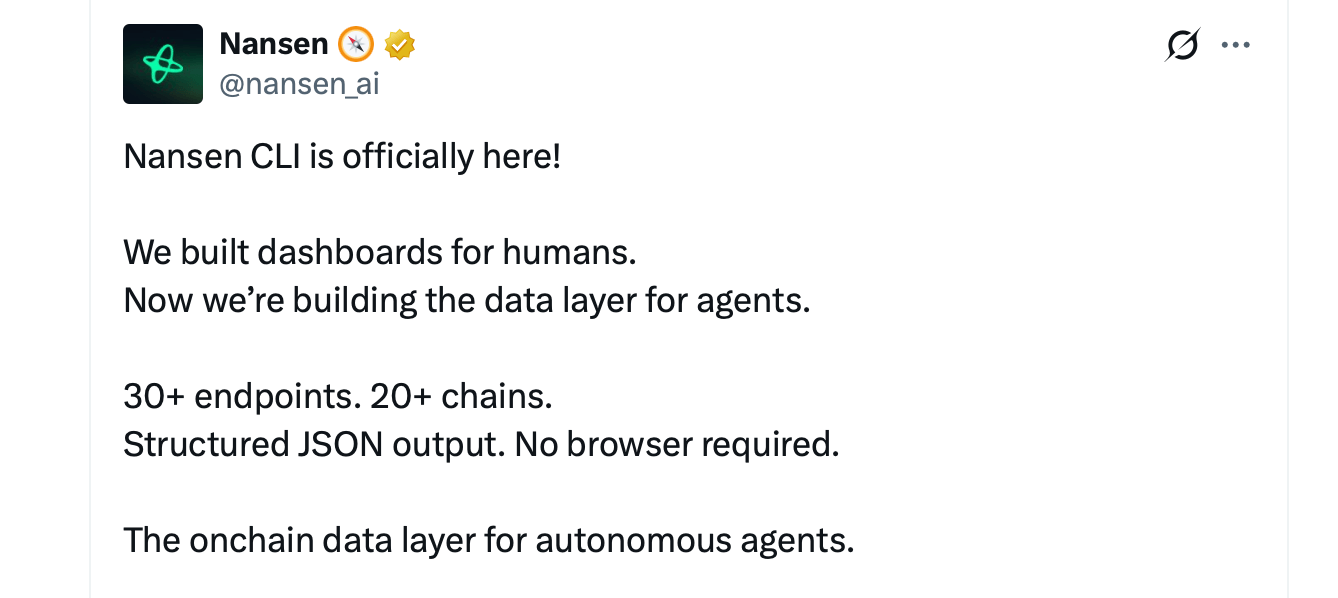
Blockchain analytics firm Nansen introduced a command-line interface tool that allows agents to access blockchain intelligence, including smart-money tracking and token analytics. The blockchain security firm specializing in smart contract development and protection, Openzeppelin, released agent skills this week.
Meanwhile, Dune Analytics rolled out an MCP server on March 2 that allows AI agents and LLMs to pull onchain data from more than 100 blockchains. Agents can run queries, generate charts, and perform structured analysis autonomously, essentially turning AI into a self-service blockchain analyst. Earlier this week, Dune wrote:
I’m excited to share that Dune MCP is now available! It lets you connect Dune directly to AI tools like Claude, ChatGPT, and Cursor. This means you can search Dune data tables, write queries, create charts, and even check your usage, all within a single prompt to your AI assistant. Essentially, it turns your AI into a highly skilled Dune analyst.
Security-focused analytics companies are also entering the picture. Anchain.ai released an MCP integration designed to provide compliance tools such as sanctions screening, fraud detection, and risk scoring. The system runs on Amazon Web Services (AWS) infrastructure and allows agents to perform blockchain investigations automatically.
Infrastructure Projects: Build the Rails for the Agent Economy
Although companies offer ways to trade and analyze markets, a new wave of projects is focused on creating the underlying systems that will enable AI to manage finances.
Payments infrastructure is evolving as well. Circle unveiled a micropayment primitive known as “Nanopayments,” capable of handling transactions as small as $0.000001. The idea is to enable machine-to-machine payments between AI agents conducting small automated tasks.
Another project, Circuit & Chisel, launched the Agent Transaction Protocol (ATXP), which is backed by support from Stripe, Polygon Labs, and Samsung Next. The protocol is designed to allow AI agents to participate in digital commerce without requiring manual human oversight.
Wallet providers are experimenting with agent-friendly integrations too. Phantom released a Connect SDK plugin on the Cursor AI marketplace that allows agents to integrate wallet functionality directly into applications.

On the Base blockchain, Bankrbot launched an updated toolkit allowing agents to manage treasuries, execute trades, and automatically fund API or language model usage through trading revenue.
Privacy and identity infrastructure is also expanding. Virtuals.io introduced an Agent Commerce Protocol designed to power marketplaces for autonomous agents while incorporating privacy layers such as Mute_swap, which draws on technology associated with Monero.
Token Creation and Onchain Automation Tools
Developers are also building tools that allow AI agents to create and manage blockchain assets directly.
op0.live released tools that allow agents to generate tokens on the Solana blockchain using natural-language commands. The system includes a zero-dependency skill package, an MCP server, and REST APIs that agents can invoke automatically.
On the Base network, Clawnch_Bot offers an automated launchpad for agent-created tokens and includes perpetual fee economies tied to the Moltbook ecosystem.
Another project, Clawdbotatg, is developing decentralized applications for liquidity vesting alongside a prediction system known as Clawdviction that allows agents to forecast market outcomes.
AI Agent Economies Begin to Form
Many projects are creating complete systems where independent, self-operating programs interact and conduct business with each other.
Fetch.ai has long pursued the idea of decentralized agent economies where autonomous programs discover services, negotiate transactions, and execute them onchain.
Bittensor stands among the most significant initiatives within the decentralized AI sector. Put simply, it aims to construct a blockchain-powered marketplace for artificial intelligence in which AI models compete, collaborate, and earn cryptocurrency rewards.

Trading-focused platforms are also emerging. Senpi AI offers trading agents capable of executing strategies on the HyperliquidX exchange using more than 45 tools and automated deployment in under two minutes.
Meanwhile, Ethy Agent is preparing an autonomous trading assistant infrastructure that expands AI trading capabilities across Ethereum-based markets.
Base Ecosystem Emerges as an Agent Development Hub
The Base ecosystem has quickly become one of the most active hubs for AI agent experimentation.
Projects such as Junoagent provide infrastructure for building autonomous businesses that operate with minimal human oversight.
Developer tools like KellyclaudeAI enable agents to deploy revenue-generating apps, including mobile applications such as FocusedFasting on iOS.
Other projects, including FelixcraftAI, focus on helping agents build and manage blockchain applications while operating at what developers describe as “CEO-level autonomy.”
Infrastructure providers like Moltlaunch and Neynar offer deployment tools, token launch capabilities, and decentralized social integrations that agents can use programmatically.
At This Stage in the Game, an Agent-Friendly Crypto Industry Still Needs a Healthy Dose of Caution
Taken together, these developments suggest the crypto industry is preparing for a future where software agents—not just human traders—participate directly in digital markets.

Whether that future unfolds smoothly remains to be seen. Autonomous systems capable of trading assets, launching tokens, analyzing blockchain data, and managing financial operations introduce efficiency but also raise questions about governance, oversight, and accountability.
Considering how quickly companies that support trading – like exchanges, data firms, and technology providers – are launching tools for AI, it seems the financial industry strongly believes AI-powered finance is here, and potentially already actively being used for trading.
Anyone trying out these new AI tools should be careful. Because they’re so new and still being developed, you can expect to find errors, strange issues, and unpredictable results. Developers are constantly working to improve them, so things are likely to change quickly.
It’s crucial to prioritize security when using new AI tools. Protect your wallets, personal information, and carefully research anything before letting it access your money or important systems. Because this technology is still developing, only use funds and data you can afford to lose, and be aware of potential risks and bad actors. The AI agent world is rapidly evolving, but it’s still under construction.
FAQ 🤖
- What is Openclaw in crypto AI development?
Openclaw is an open-source framework that enables autonomous AI agents to interact with exchanges, blockchains, and APIs. - Why are crypto companies building AI agent tools?
Companies are creating these integrations so AI agents can analyze markets, execute trades, and interact with blockchain networks automatically. - What are MCP servers in the AI agent ecosystem?
MCP servers provide standardized access to blockchain data, analytics tools, and APIs so AI agents can retrieve information securely. - Which crypto companies are releasing AI agent skills and tools?
Major contributors include Binance, Crypto.com, OKX, CoinMarketCap, Dune Analytics, Fetch.ai, Autonolas, Circle, and multiple projects within the Base ecosystem.
Read More
- Brent Oil Forecast
- CNY RUB PREDICTION
- 🚀 Crypto ETF Hits Wall Street: Your Wallet’s New BFF! 🤑
- JPMorgan Boosts Core Scientific’s AI Push with $500M, Total Financing Hits $1B
- 🚀 Trump Ends Shutdown, Crypto Soars: Is This the Dawn of a New Era? 🤑
- GBP AED PREDICTION
- SUI PREDICTION. SUI cryptocurrency
- INJ PREDICTION. INJ cryptocurrency
- Kazakhstan’s Stablecoin Fee Revolution: Who Knew Paying Could Be This Crypto-Fun? 🎉
- Crypto’s Carousel of Whimsy: $50M Bet on Jito’s Staking Waltz 🎩🪩
2026-03-07 19:01